
Garza Release Dates Mean Different Things
TDCJ uses the exact label Projected Release Date for a date calculated by its Classification and Records Office. It means projected release from incarceration if parole does not occur sooner. It is separate from Parole Eligibility Date, Next Review Date, Maximum Sentence Date, and the historical actual release date.
A pretrial detainee at Garza County Jail often has no scheduled release day. A judge may set bond, dismiss a charge, issue another order, or leave a case pending. A sentenced county inmate may have a term and jail credit, but the jail and court records still control. Someone at Giles W. Dalby Unit belongs to the TDCJ system, even though the prison is in Post.
Find a Garza Projected Release Date
Begin with the agency holding the person. A county booking number does not search a state prison record, and a TDCJ number does not prove a Garza jail release. Match the name with a birth date, SID, TDCJ number, cause number, or county and court of conviction.
- For a TDCJ prisoner, use the official offender search and open the full matching record.
- Record the projected release, parole eligibility, next review, maximum sentence, status, location, offenses, and access date as separate fields.
- If older history is missing, use TDCJ's official email information channel.
- For a county sentence, ask Garza Jail for the commitment, jail-credit calculation, release authorization, and applicable local good-time policy.
- Obtain the judgment and later orders from the correct Garza clerk track.
- Check any transfer or detainer in the receiving system before calling the date final.
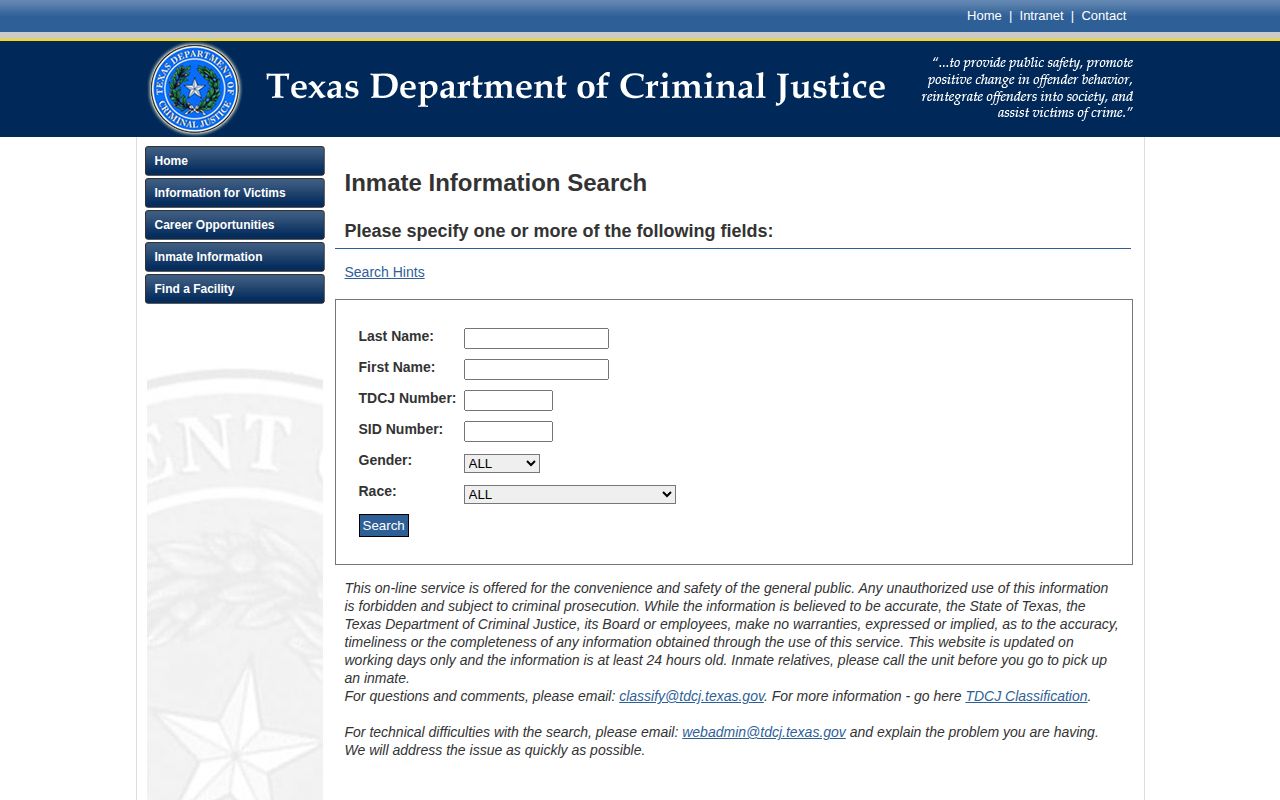
The TDCJ offender search accepts a last and first name, TDCJ number, or SID number, with added descriptors available in the interface. Compare the county, court, sentence, and offense before attaching a result to a person.
TDCJ Fields for Garza Release Lookup
The search is strongest when its fields stay distinct. “Not available” is not a date and may reflect ineligibility or processing. A projected date does not show that a parole panel has voted, while a review date does not say release was approved.
| Field | What it answers |
|---|---|
| Projected Release Date | Current TDCJ estimate if parole does not occur sooner |
| Parole Eligibility Date | When review authority may begin |
| Next Review Date | When another board review is expected |
| Maximum Sentence Date | Sentence endpoint shown by TDCJ |
| Status or location | Present TDCJ custody information |
| Actual release history | What occurred, when available from TDCJ records |
The official search screenshot below shows the state entry point used for a current record.
Email TDCJ for Garza Release History
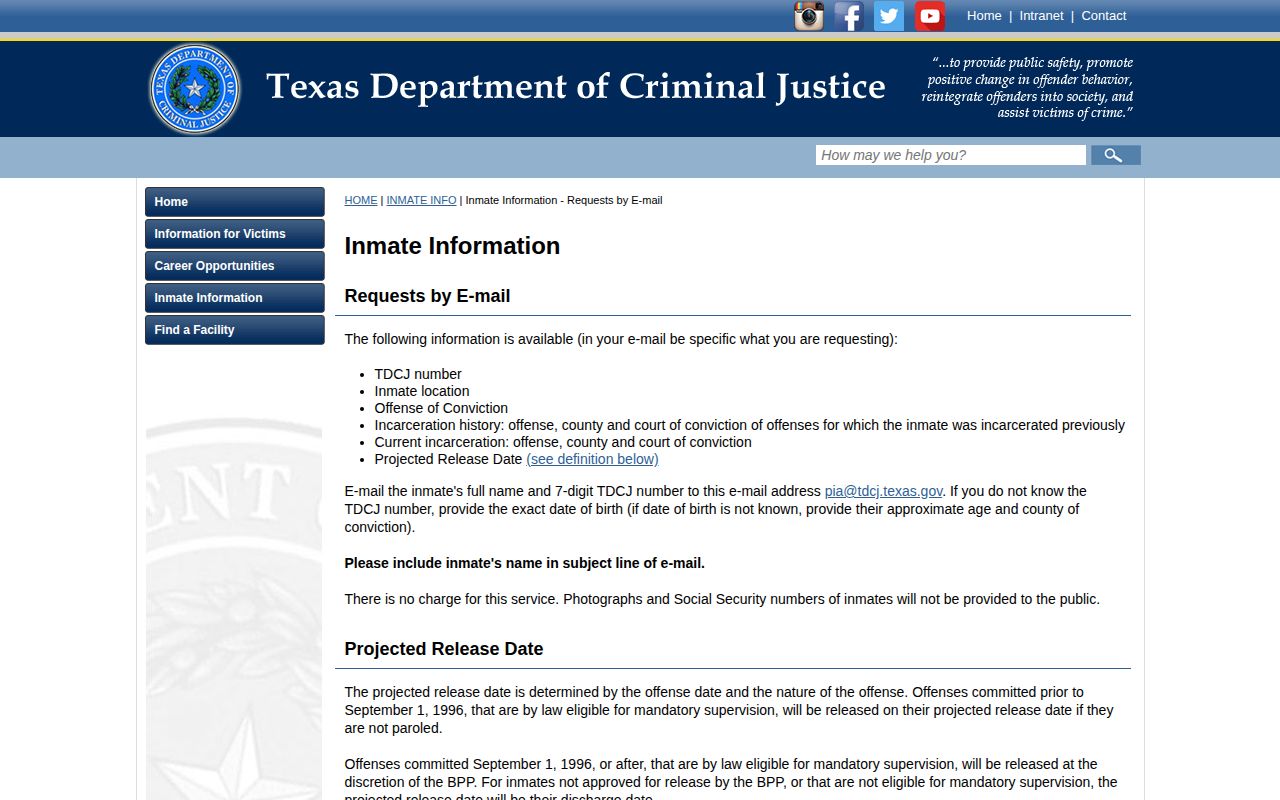
A released person may not remain as visible in an interface built around current custody. TDCJ's inmate-information email route can supply the TDCJ number, location, offense, prior incarceration history, county and court of conviction, and projected release date. Put the person's name in the subject and give the full name plus seven-digit TDCJ number. If the number is unknown, provide the exact birth date, or approximate age and county of conviction.
TDCJ states that this information service has no charge. It does not supply photographs through that route. Ask directly for actual release history, release type, and discharge or supervision status when those are the facts needed. The official TDCJ instructions shown below define the channel and the projected-date field.
What Changes a Garza Release Date
A calculation can change after the first display. TDCJ applies the current sentence data, classification, credits, eligibility, and legal restraints. A court can amend a sentence. A disciplinary event can affect credits. A new case or a hold from another agency can stop community release even when one custody term ends.
| Change | Possible effect |
|---|---|
| Good-conduct classification | Credits may alter eligibility or a projected calculation |
| Forfeiture or restoration | The displayed estimate may move |
| Parole decision | Release may occur sooner, later, or not after review |
| Detainer or new case | Custody may pass to another agency |
| Consecutive sentence | Another term must be included |
| Program or release plan | Administrative prerequisites can delay execution |
A move between TDCJ units is not release. Likewise, departure from Garza Jail can be a transfer to TDCJ, another county, federal custody, or ICE. The destination field is crucial.
Texas Good Time for Garza Records
Texas has no universal rule that every prisoner must serve 85 percent. Government Code Chapter 498 governs TDCJ good-conduct time. Credits may reflect classification and program participation, can be forfeited for misconduct, and generally affect eligibility or projections rather than rewriting the sentence imposed by the judge.
Government Code Section 508.145 uses different eligibility rules. For certain serious offenses and deadly-weapon findings, subsection (d) generally uses actual calendar time equal to half the sentence or 30 years, whichever is less, with a two-year minimum. Good time does not reduce that calculation. Capital-life and other categories have separate rules. Section 508.149 also excludes listed people or offenses from mandatory supervision.
For eligible offenses before September 1, 1996, TDCJ explains that the projected date can become the mandatory-supervision release date if parole has not occurred. Later eligible cases may face discretionary BPP review. These rules concern eligibility and state calculations, not a guarantee of release.
Garza County Jail Date Calculations
County-jail time follows a different record chain. The judgment and Texas Code of Criminal Procedure govern credit for confinement before sentence. Sheriff classification or work provisions may affect applicable local good time. A TDCJ projected-date formula must not be imported into a misdemeanor county sentence.
Ask Garza County Jail for the commitment, credit calculation, release authorization, actual timestamp, and any policy applied. Then compare the court judgment, bond order, dismissal, modification, or revocation. The court document explains authority, but the jail event shows when custody ended or a receiving agency took control.
The Garza County release-record guide gives the full request path and field list. A narrow request should identify the booking event and ask for release type and destination rather than merely asking whether the person is still there.
When Garza County Sentences Discharge
Texas Code of Criminal Procedure article 43.13 generally places county sentence discharges between 6 a.m. and 5 p.m. That statutory window does not establish Garza County Jail's precise gate time for a named person. Processing, another hold, transport, and the legal release route still matter.
This local distinction is especially important because a county discharge does not use the TDCJ calculation. For a state prisoner, review the official projected field and later actual history. For a county inmate, follow the commitment and jail event. For a pretrial detainee, obtain the bond or court action and physical release record.
Note: Report a date as projected as of the access day until a custodian confirms the actual event.
Confirm the Garza Actual Release
Once the expected day passes, return to the source system. TDCJ history should show the executed state event and whether parole, mandatory supervision, or discharge followed. Garza Jail should supply the booking release or transfer timestamp and destination. A federal BOP date concerns BOP custody only, while an ICE locator is mainly for present detention and no match is not proof of release.
Notification can help, but it is secondary. Texas IVSS-Counties may send a participating release or transfer event. Verify that notice with the custodian because former inmates may disappear from the portal. The VINELink Release Check guide explains the current IVSS successor and the limits of a missing result.
Keep the planned date, actual event, release type, and destination in separate notes. That small step prevents an eligibility date, favorable vote, court order, or transfer from being mislabeled as freedom to the community.
Document a Garza Release Date
A clear record note should name the custodian, exact field, matching identifier, and access day. For TDCJ, preserve whether the field said projected release, parole eligibility, review, maximum sentence, or actual release. For Garza Jail, ask for the booking number, physical release time, release code, and destination. If a court order explains the authority, keep its cause number and signing date beside the jail event rather than merging the two.
This method also exposes a transfer. Someone can leave one facility while remaining in custody elsewhere. Search the named receiving agency and allow time for intake processing. Only an affirmative community-release event should be described as release to the community.
Public Record Search
Sponsored Results