
Garza Parole and Probation Compared
Texas calls adult probation community supervision. A Garza court imposes it instead of, or after, part of a jail term. Parole follows a TDCJ prison sentence and begins only after action by the Texas Board of Pardons and Paroles. Mandatory supervision is another conditional TDCJ release. Bond is different from all three: it permits release while a case continues and does not, by itself, create probation or parole.
The source record follows the legal path. A Garza court judgment or later discharge order is the sound record for probation. A TDCJ offender record, BPP vote status, and Parole Division record control parole. The jail can confirm when custody ended, but it cannot turn a bond release into a supervision finding.
| Question | Probation | Parole |
|---|---|---|
| Who orders it? | A trial court | BPP after TDCJ review |
| Who manages it? | Community supervision department | TDCJ Parole Division |
| Best proof | Judgment, order, or discharge | TDCJ status and Parole Division confirmation |
| When it ends | Court or department discharge | Sentence or supervision discharge |
Verify Garza Post-Release Supervision
Start with identifiers, not assumptions. Use the full name, date of birth, cause number, TDCJ number, or State Identification number when available. Similar names can point to different people. The county of conviction also does not prove where someone now reports. A person may live in Garza County while another regional office holds the assignment.
- Determine whether release followed a Garza court case or a TDCJ prison term.
- For probation, request the judgment, probation order, modification, revocation, or discharge from the correct Garza clerk track.
- For parole, open the official TDCJ Offender Search and match the person by number and conviction details.
- Read BPP status with the agency glossary. Do not convert an eligibility or review date into a release date.
- Confirm the assigned office with the supervising agency before relying on a county map.
- Record the field label, date checked, matching identifier, and agency that supplied the answer.
If the public TDCJ interface lacks older history, the inmate-information email channel accepts a full name and seven-digit TDCJ number. When the number is unknown, TDCJ asks for an exact birth date, or an approximate age and county of conviction. Ask for incarceration history, actual release, and supervision or discharge status.
Garza Supervision Offices Are Separate
The local adult probation office handles court-ordered community supervision. It is not a parole office. The official Garza probation page is the source for its local contact. Staff disclosure can be limited, so a court record remains the durable way to show that a judge imposed or ended probation.
Garza Adult Probation
102 S. Ave. L
Post, TX 79356
806-495-4442
Fax: 806-495-4444
TDCJ maps Garza County to the Lubbock District Reentry Center and District Parole Office. That mapping helps route a call, yet it does not prove a named person's assignment. Confirm the office from the person's state record or with Parole Division.
TDCJ Lubbock Parole Office
1720 E. Regis St.
Lubbock, TX
806-747-8282
Note: Call before visiting because a county service map is not an individual assignment record.
Garza Parole Review Is Administrative
Ordinary Texas parole consideration is a file review and panel vote, not a formal public hearing with a Garza County calendar slot. Parole Division identifies a case about six months before initial eligibility and about four months before a later review. An institutional parole officer develops the case summary. Three panel members vote, and two concurring votes decide the result. Published process ranges describe workflow, not an appointment or release promise.
The BPP review process explains the stages. For an individual pre-vote status, the researched BPP line is 844-512-0461. After approval, release-status questions go to Parole Division at 512-406-5202. A status check should preserve the code, check date, and next-review information.
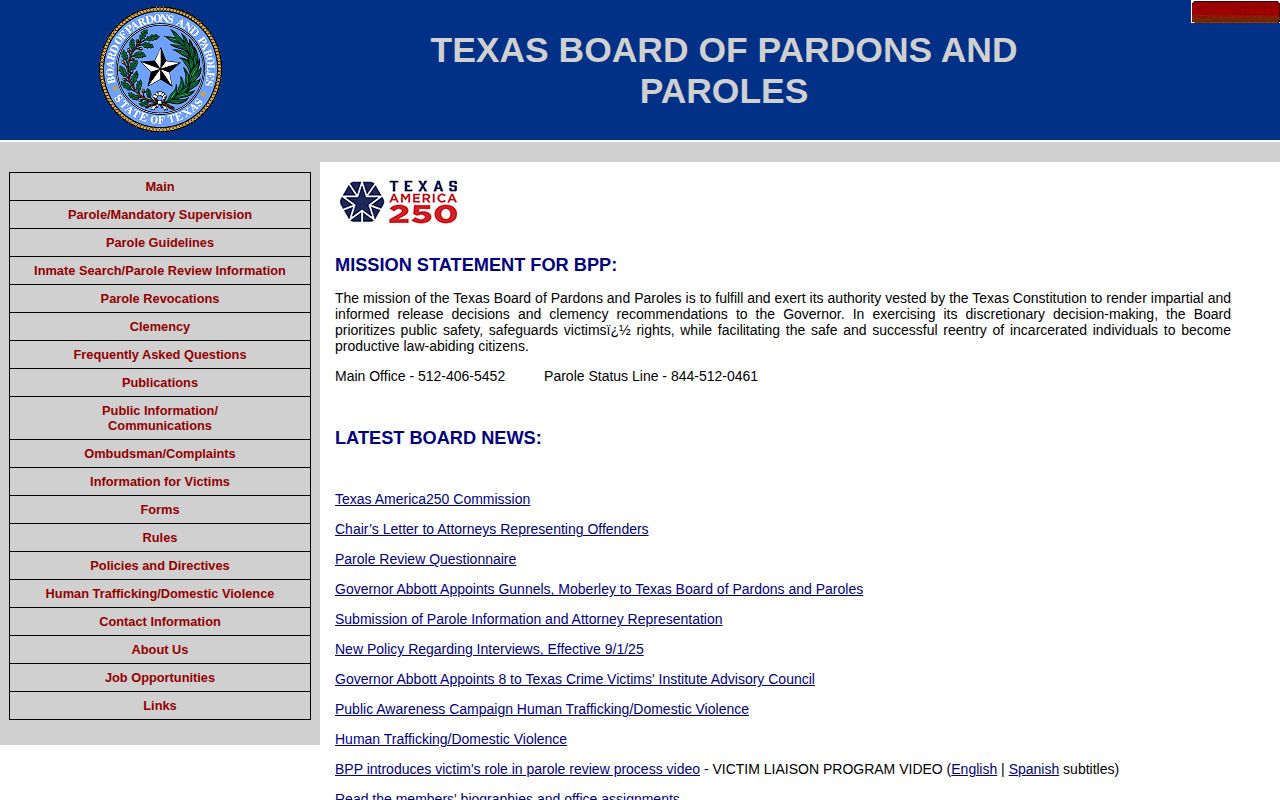
The official BPP page shown below is the proper starting point for current board information.
Read Garza Parole Vote Codes
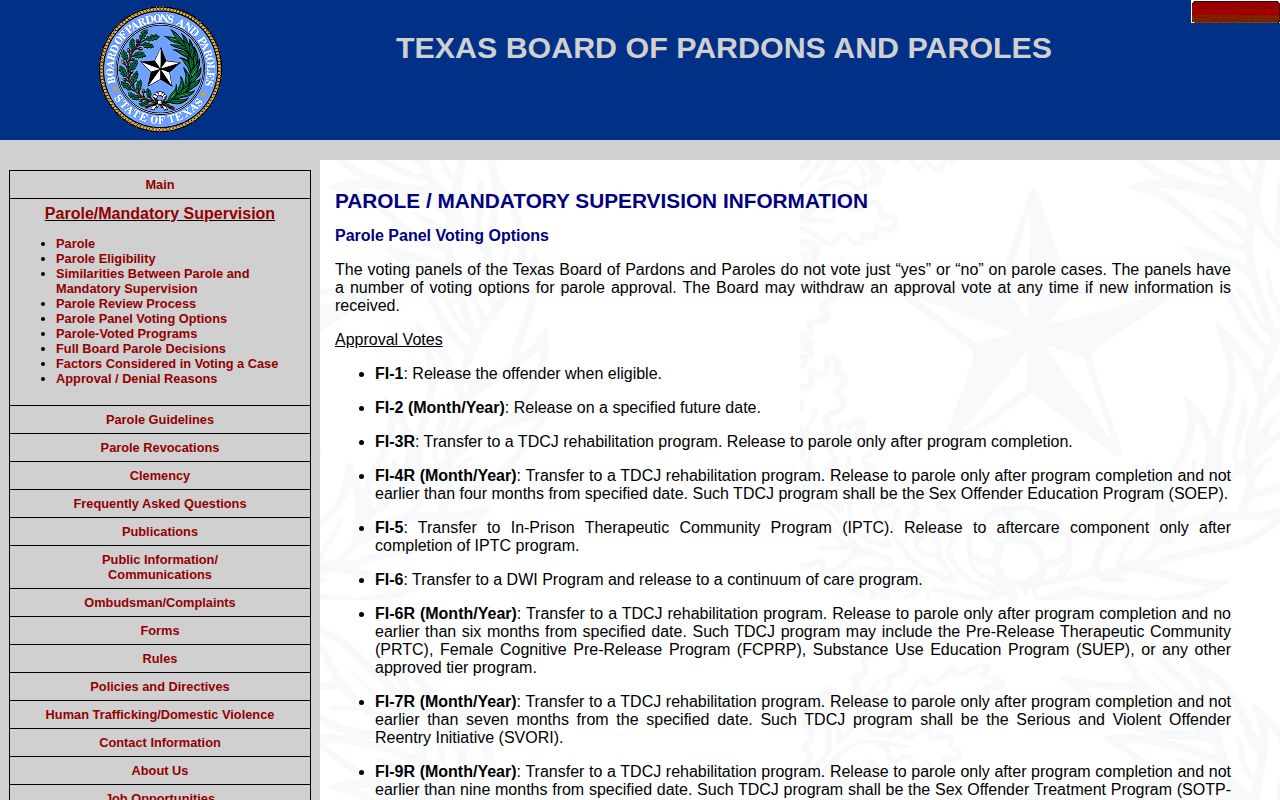
A favorable code is not always a gate-out date. FI-1 generally means release when eligible. Other FI codes can name a future date or require a program first. RMS concerns release to mandatory supervision. Denial codes include NR, which identifies a next-review month and year, SA, which requires service of the balance subject to applicable mandatory supervision, and DMS, which denies mandatory supervision with later review.
Use the current BPP vote-options glossary rather than guessing from initials. A grant may be withdrawn if new information arrives. Review and Release Processing must also clear an approved plan, detainers, consecutive sentences, programs, special conditions, and new cases before physical release.
The official glossary capture illustrates why the exact code matters.
Garza Supervision Violations and Warrants
Conditions vary by the controlling order or release certificate. Common duties can include reporting, travel approval, program participation, or compliance with special conditions, but only the person's documents establish the actual terms. A missed contact does not let a third party declare a violation. The supervising office determines compliance and follows its process.
An absconder label means the agency reports lost contact or noncompliance. It is not a new conviction. TDCJ has a Sex Offender Absconder Information Search, while the Texas DPS registry covers a wider group with registration duties. Neither is a list of all people on parole. A warrant must be confirmed with the issuing or supervising agency, and no Garza County parole-absconder list was found.
Texas IVSS-Counties can carry participating custody or supervision events, but it is not the record custodian. Garza participation must be checked in the portal or with the Sheriff. A missing IVSS result does not show discharge, compliance, or release.
Garza Supervision Record Proof
Different records prove different steps. A judgment can show that a court ordered community supervision. Later docket entries can show a modification, revocation, extension, or discharge. For parole, the TDCJ record identifies the state case and BPP stage, while a release certificate states conditions that apply after prison custody. Parole Division then holds the supervision record. One document should not be stretched beyond the event it records.
When dates conflict, ask which event each date labels. A board vote date, projected release date, physical release date, first report date, and final discharge date can all be valid. They answer separate questions. Match the identifier on each source and keep the issuing office with the date. This prevents an old favorable vote from being presented as current parole and stops a jail exit from being mistaken for the end of a court sentence.
Dalby Reentry Before Garza Release
Giles W. Dalby Unit opened under TDCJ with institution-specific transition programs. The state announcement describes a six-month Serious and Violent Offender Reentry Initiative based program for parole-voted participants, a four-month corrective intervention pre-release program, a sober-living dorm, and religious and life-coach resources.
These programs are not proof of eligibility or completion. They also do not show that someone will leave directly from Dalby. A person can move to another TDCJ unit, face a detainer, or await a release plan. Current TDCJ status, the release certificate, and actual history provide the reliable chain. The Garza County released inmate search and records guide explains how to follow a transfer across county, state, federal, and immigration systems.
How Garza Supervision Ends
Supervision ends through the authority that created it. For probation, seek the Garza court discharge or final order and check whether a revocation or modification changed the term. For parole or mandatory supervision, obtain TDCJ or Parole Division status showing completion or discharge. A jail release timestamp answers when custody ended, but it cannot prove the later end of supervision.
Parole eligibility is only the point when the board may consider release. Government Code Section 508.145 sets different paths by offense and sentence, while Section 508.149 lists mandatory-supervision exclusions. Even a favorable vote can remain subject to legal and administrative checks. The final record should distinguish the review, actual prison release, supervision start, and discharge as separate events.
Note: Keep each dated record separate so an old parole review is not mistaken for current supervision.
Public Record Search
Sponsored Results